Sunday, 6 September 2015

L'ombelico del Mondo


I subscribe to the notion of "Why not?", rather than limiting myself to possibilities that fit neatly into boxes. So when I saw a banner online advertising the opportunity to volunteer at the Expo in Milan, I applied, not really thinking that it would work out. It did, and for two weeks at the beginning of August this one rolled her suitcase to Italy to eat pasta, meet new people and be in a place where she did not know the language.

The first hurdle was getting there: as we had to attend an introductory meeting on the Thursday and there were no suitable flights from Hamburg (18h layover in Bruxelles, anyone?), I took the train to Berlin, spent an evening there and left early the next morning. Since Ryanair lands at Malpensa Airport, it takes another hour by bus to reach the city. Berlin had been cool enough to wear a leather jacket over a blazer, but any layering proved detrimental as soon as I stumbled onto the sidewalk next to the central station - beads of sweat started pearling on my top lip and the feeling of sweating what could well fill a swimming pool didn't stop until I boarded a different plane heading back to Germany.

At the central station, I embarked on a linguistic adventure by trying to buy a two-week pass for the underground. None of the four tellers could speak anything except Italian (being multilingual this was very annoying, as normally I can get by with jumbling all Romance or Germanic languages), but after half an hour of drawing images and pointing at a calendar the friendly man and I seemed to have reached an agreement on what I wanted, and I walked out with a metro card. Sadly, it turned out to be only for the inner city, and the Expo is situated riiiiight outside of this. So near, and yet so far. The linguistic-ticket adventure continued the next day with the help of Italian volunteer Anna, who sacrificed some time to help me with the ticketing dilemma, but it all worked out (basically because I just nodded and Anna told me when to pay).

From there I rolled my suitcase to a bench near where our meet up would be. Ever so often a whiff of dog piss would waft over and pigeons were trying to camp out on my suitcase, but I feared moving since I'd probably get lost. When I did walk the last metres to the Fondazione Stelline where our group would be meeting up, I noticed that the bench I had been chilling on was right next to Santa Maria delle Grazie, the church where Da Vinci's Last Supper is housed. Despite efforts during the following weeks to get an appointment to go in, everything had been booked solid weeks in advance and sadly I never managed to see it (but am finding solace is knowing I had kind of lain near a masterpiece).

After meeting everyone, getting various passes and official outfits, the group headed to a student residence just south of the Duomo, which would be our accommodation during our stay. The next two weeks had a similar daily rhythm: the first shift would meet up in the lobby, take the train to the Expo together, work the shift, have lunch together and then little groups would explore different pavilions or head into the city. For dinner we'd sometimes could something together or those on the upper floor would hang out on the terrace. Then the same thing would happen again the next day.

Empty Expo site.
Ecuadorian National Day.
Wicked headdress in even worse heat. 
Going to the Expo, I had no idea what I was in for. I pictured it like working at Disneyland, perhaps with a few more serious tasks as this was the EU pavilion and not Space Mountain. Working there provided the chance to see the inner workings of such an enormous gathering (it runs from May to October, with 154 countries represented and 29 million visitors expected) and thus also question its relevance and validity. The construction of the Crystal Palace in 1851 in London or erecting the Eiffel Tower in 1889 in Paris was a feat of human endeavour, and represented the rapid advancements that came with industrialisation, colonialism and a general restructuring of the Western world as it had to accommodate both the masses of people flocking to the cities and the ideologies they were bringing with them. Naturally, the 19th century is also a time of questionable morality, as during the Expos people from the different colonies were exhibited like animals for the amusement of the visitors. And yet I consider them to represent a sort of Internet of the times, where everything new and miraculous and exotic could be found under one roof. The Expos then made sense as they represented a brave new world to millions of people that otherwise would not have had the opportunity to expand their worldviews (albeit that this presentation was a feat of political manipulation to underline the power of various Western empires at the time).

Pavilion Zero, where the history of food is traced. 

But after spending two weeks visiting various pavilions, the Expo seems redundant and more a space for showing off who has better financial means than an honest interaction with this year's theme of "Feeding the Planet, Energy for Life". The central idea was to interrogate how we could ensure food for the 9 billion people that will be weighing down the planet come 2050. Some pavilions did a great job at questioning this: Germany handed out cartons that turned into displays as one progressed through the exhibit and held them under various lights. I appreciated the information being presented in a way that was interesting both for children and for adults, and also the matter-of-fact approach (this is the problem, this is what we are doing/planning to do). As the only African country not being stuck somewhere in a cluster and pedalling wooden craftsmanship, Angola had different levels explaining the basics foods consumed in the country and the important role that women play in Angolan society. The UK combined art and beekeeping in the shape of a metal beehive whose sounds echoed those of a real one in some British city. Their emphasis was on the necessity of bees to human survival, as without them we would die out in four years.

German cartons making sense. 
Germany: practical advice to take home.
Germany, still. 
The UK
The UK Hive
From the outside. 
Angolan Ladies. 
In contrast, Qatar had creepy holograms and showed how they had to import everything. Kazakhstan was very popular as it had a 5D film, which, I will not lie, was amazeballs. And yet, despite them stating at the entrance that they had the "resources to feed the world", the visitors were rushed quickly through the content area (all I could see was that they had run our of horse milk and had some strange fish in a pond) to the film, which then took you on a magical carpet ride through the country whilst also providing tidbits of information (9th largest country in the world, conservation area the size of Belgium). Austria illustrated how we cannot survive without air (true, but this was a food expo). The US had vertical gardens, where I wondered who ever went up and picked the berries and chillies hanging there.

Kazakhstan in 5D
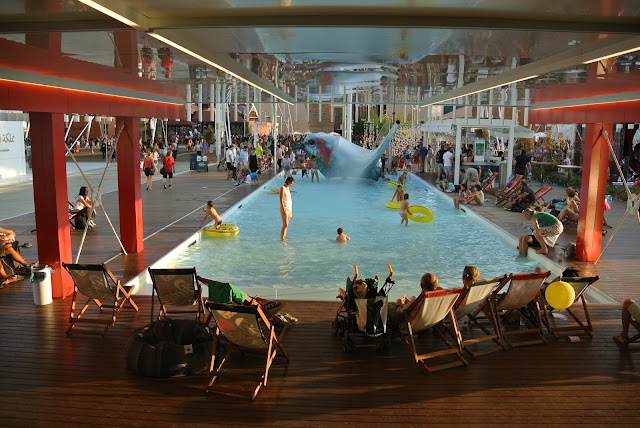
The Czech Republic's great pool. 
Austria.
Still Austria.
The USA.
Pick me. 
Naturally, I have a limited interpretation as I didn't view nearly as many pavilions as some of the other volunteers or visitors and am also not familiar enough with the political and cultural histories of the various countries to make a fair and accurate judgement. Perhaps I am naive in my interpretation of what an Expo should be for, perhaps there are just too many players here gunning for the same ball, or perhaps it is evolution and the planet is simply not meant to feed 9 billion people. But whilst working at the EU pavilion, I was faced daily with the unhappy statistic of 1/3 of all food in Europe being wasted yearly as it flashed onto the screen in between people from all 28 countries saying "Hello, welcome, oi oi savaloy". Now knowing about this wastage, consider the World Food Programme's hunger statistics of 1 in 9 people going hungry everyday, or of 1 in 4 in Africa being undernourished, or (inner feminist shuddering) that "if women farmers had the same access to resources as men, the number of hungry in the world could be reduced by up to 150 million". Is this not what we should be talking about? Is this not the point of "Feeding the Planet"? Is this not what the 28 million visitors are coming through the gates for?

Listen, I am not all doom and darkness. The weeks at the EU pavilion provided the opportunity to gain valuable insights into how the Union works, on how delicate political relationships need to be handled (case in point: India being absent from the Expo as there is some beef with Italy for Italian marines having mistaken Indian fishermen for pirates and thus shooting them dead. Now India wishes the marines to be tried in India, as they were in Indian waters, but Italy is refusing to hand them over. Something like that) and how human error seeps in everywhere, especially into events of this magnitude. I also learned what Snapchat was for (ok, I still don't get it, but I have downloaded it), how to say bad words in Italian and how to compromise when my personal desires contradict with what the group wants to do. This was a great group of enthusiastic young adults who want to make the world a better, more accepting, more integrated place and who were all very willing to both share their own culture and learn from others (yay EU).

But on the last night of our stay, we all gather on the roof of the pavilion to witness the marvel that is the Tree of Life, an interplay of light, water and music that makes the crowd cheer every time (and every half hour if I remember correctly). Everyone was tired but exited as we drank Aperol Spritz or beer and looked down on the masses that had gathered below to see this display. People were taking uncountable group photos and already reminiscing about how we'd stay in contact and never forget this.

Aperol for all. 
And that is when I realised that the simple answer is no. No, people do not want to pay to be informed of hard truths. They want to come to marvel at human innovation, they want to be astounded, they want to see that despite the world rushing forward at the heart of humanity there always beats the hope that we, with our ingenuity and mastery of machines, can handle whatever comes next. And despite me thinking that when shit hits the fan it'll all be a somewhat different story, for one moment there I could believe that all one needs to achieve happiness is an amazing choreography of lights and water bursts to the sounds of Ombelico del Mondo.

Shine baby shine. 

Thursday, 27 August 2015

All the luck in the world

I can hear the boats creaking, the waves clashing against their hulls.
Cars rumble past, at times with a momentary hint of loud music.
Then the up-and-down creaking is back,
Almost clock-like,
A thump-thumping in the night.
The occasional gull caws.
Voices of people walking past at this time, no longer today but tomorrow. 
Then the creaking returns.
And all of this life I listen in on 
from the comfort of my bed. 


Today I said the first "see you soon". I hadn't thought about having to say goodbye, about probably not seeing people again, about things ending. All the packing and panicking has been occupying my mind and my time. Moving is such bullshit. Throwing away things, wondering if you should be on Hoarders, packing things as efficiently as you can possibly imagine (the threat of having to move everything in one car always looming, the constant questioning of where everything came from, and then the stress of hauling the stuff around. Strange how we attach meaning to objects that we could very well live without. This sedentary lifestyle, enabling us to believe there is value in keeping things.

Tomorrow I pack up the last bits and move everything to the ground floor before friends come over for a last celebration. And on Saturday it is really goodbye. Damn. How time flies when you don't know what the hell you are doing.


Wednesday, 26 August 2015

Met jou klere aan

Skooltyd moes ons 'n internskap doen.
Vir 'n week was ek by Protea Boekhuis in Hatfield. In die oggende het ek met die bus stad toe gery, my Discman in my sak en die CD van die dag gereed vir die uur wat ons deur Pretoria sou ry. By die werk het ek nie juis veel gedoen nie. Ek het in 'n hoekie gesit en manuskripte gelees, meer kan ek nie onthou nie.

Een van die vrouens wat daar gewerk het het dié sin teen haar muur vasgeplak, en ek sal dit nooit vergeet nie: vir julle skryf ek susters, wat in die liefde geval het, wat gebreek het soos borde.

Nou, meer as 10 jaar later, kry ek die hele gedig van Sarina Dönges aanlyn:


My arme susters

vir julle skryf ek, susters,
wat in die liefde geval het
wat gebreek het soos borde
of dunner, soos Venesiese glas

julle wat die snykant
van nagdinge ken

aan julle deure sal kom klop
die woordgeleerdes en fariseërs
uitgeswel soos somervrugte, immuun
teen die steekvlieë van die sonde.

julle wat gesmul het
aan gesteelde pere

sal snags in Mosesmandjies lê
op 'n meer van Valiums
die lakens sal julle vasrank
soos plante 'n vermoeide huis.

julle wie se minnaars wortelskiet
langs hulle geil vrouens,

julle sal opeens weet, liewe susters,
(julle lywe uitgeskud soos meelsakke)
dat julle bloot 'n bestanddeel was
nooit met liefde gesuurdeeg nie;

julle was peuselkos
aptytwekkers voor 'n maaltyd

ag, my arme susters.

Tuesday, 25 August 2015

Now you're lost/Lost in the heat of it all/Girl you know you're lost/Lost in the thrill of it all

I grew up leaving, always leaving. Packing bags, moving again. New place, new friends. Not a bad life, right?!

But it also made me think that leaving was the only place I could go. After school all I wanted was to leave, to not see this city, these friends, this family, not seeing what had raised me. There was so much more to discover, there was this world of experiences that I wanted to have and which I imagined wouldn't be possible in Pretoria. 

I hadn't yet learned that leaving is a lonely endeavour. It involves a host of questions ranging from the banal to the life-altering: Where to go? For how long? What to pack? What administrative documents would be necessary? Would I be missed? Should the favourite books really come along? It also shifts between an attachment to things and an attachment to people. Leaving is selfish, leaving is choosing what you want above what others might need from you in staying.  

I didn't care. Because you see, I needed, desperately, to see - see anything, everything, absorb all the visual cues possible. These past two years, I have had my fill. There have been countless concerts, festivals and trips across Europe. I have spent hours in buses, trains and other public transport. I have lugged around my luggage and bought items as reminders of these travels. I have seen cities, gone to their tourist attractions, visited exhibitions, eaten the specialities and gotten lost. I have had films developed after a few months that spanned all of these roads taken. As I said, I have tried to gobble down this place because coming here needed to have mattered.

And it has. I may not have done much academically, but even the darkest days here have been a learning curve. Sure, I still don't know where or as what I'll find gainful employment after these wanderings. I still struggle with being an adult. But there has been a settling of my person, a certainty that comes with knowing who you are, what you like and being unafraid of wanting a particular life. Just as the centre of gravity shifted downwards to the pelvis from the Australopithecus to modern Homo Sapiens to enable bipedalism, my own sense of self seems to have reached an agreement with my insecurities. I know that I am not without value, not without wit and humour and talent (even if all it amounts to is quoting rap lyrics at appropriate times). What a thing, to start liking oneself at 27.

As I write, most of my furniture has been sold off and I am packing my things. Leaving, again. This time for Paris, again with just a suitcase and the hope of being a better version of myself in a new but familiar place. After three months, two flights will take me home to contemplate what comes next. All I know is I want to stop leaving.


Monday, 6 July 2015

Small things

17 minutes. She gave me 17 minutes before uttering her token sentence "so het ons maar ons dinge" (unsure of how to translate this, perhaps a mixture between 'that's life' and 'everyone has their own problems') and hanging up. My grandmother usually manages a maximum of five minutes of telephone conversation. Usually she'll tell me what she has been up to and then end the call by asking when I'll be back.

Maybe I got 17 minutes because I had an answer. December. 3 months, no plans.

She tells be about all the cousins, their weddings and the birth of the first great-grandchild and her neighbour Oom Boet gardening with a cane and his wife having broken her hip and that trip in the 80s to Germany before the wall fell and my ouma's own flu at the moment. Nothing is repeated, she appears as always. At 85, she has lost the ability to recall what happened a few minutes ago, but not what happened decades ago. I am told about old trips with the grandfather I never met, about what her plans for the day are, about what we'll do for Christmas.

It's a phone call, nothing big really, but in times of uncertainty it's the small things.

So het ons maar ons dinge, ne.

Thursday, 2 July 2015

I walk until


We ate Paris. There is no way around it. We turned the city of love into the city of a love for food.

It already started on the train ride to Hamburg: all I had were some delicious cherries and a chocolate flavoured milk, still bought the evening before in Denmark. The cold had not left Germany yet, so I was dressed warmly in jeans, sweater and leather jacket. Upon my arrival in Paris, the layers had to come off. Finally, it was hot.

The first night was spent reuniting with an old friend and her fiancé, in the city by coincidence. We bought a baguette and cheese (and wine), headed to the Ile de la Cité and sat down amongst Parisian youngsters also enjoying the heat, the river and some impromptu jamming on a guitar. B and JH and I just fell easily into old conversation, caught up on gossip and contemplated our futures. After having spent six weeks in Nantes shooting a TV series, both of them were ready to go home, and as she said it, be around 'our people'. By my mense. Another friend, also from SA but now in Toronto, posted something about how all we are is the communities we surround ourselves with. I don't know what it is, but we all seem to have a strong sense that were we are is not home. We long for long dinners that end in the kitchen at 4AM, for cheap wine, for boerewors and braais, for speaking Afrikaans, for fresh fruit that doesn't cost an arm and a leg, we long for our people.

But how do you reconcile wanting to be there with also wanting more than that? I don't miss the crime, I don't miss having to have a car, I don't miss enormous shopping malls and traffic and fear and poverty and politics and problems. Yesterday I went to a free film screening at the university and at 1AM cycled home all by my lonesome. The impossibility of this at home! This nomadic lifestyle is walking the line between missing home but knowing there are other choices one could make.

Choices like what to eat next, haha. The rest of the week was spent hanging out with my friend L. Even buying groceries together was a tiny adventure: we went to Lidl, but getting there involved walking through a couple of streets where it seems all the hair and nail studios of Paris have lined up. They cater for African hair, so we weren't really eligible for getting our hair done. But even more fascinating were the guys hanging out in front of the salons: fit young men with gold chains would approach women on the street to get their nails and hair done. What would the job description be? Hustler? Nail-pimp?In Lidl itself we were treated to the spectacle of an older couple (75ish) being accused by a younger lady of being inhuman, and then shouting at one another whilst the rest of the store looked on. Not a bad start to the week, I think.
Lidl lunch. 

Our culinary tour took us to L'As du Fallafel, which was a lot of garlicky sauce with a couple of fallafels tossed in a pita bread, and which L really liked and I really did not. After having stalked Jamie Oliver's head pastry chef on Instagram, I insisted on going to L'Éclaire de Génie, which has fabulous looking éclairs and barquettes with wonderful flavour combinations. L wanted some froyo instead, but as we found none in the Marais she settled for a McFlurry. I should have maybe saved my 7€ and gone for a McFlurry, too, since the berry barquette was somewhat disappointing.


There was a queue of 30 people at l'As du Fallafel, and at the place right across the street just one lady.

Éclaire de génie. 


We explored the Marché des Enfants Rouges (oldest market in Paris), which hosts an arrangement of food stalls, but as we were there rather early we didn't sample anything. Instead, we headed back to our quartier to get some ice cream at Baci Bisou, a place near the Quai St Martin. I got fleur de lait and noisette topped with Nutella and white chocolate (all in mofos), soooo good.


We tried some really terrible spring rolls (none of the Chinese eateries we saw make them fresh, they are pre-deep fried and then heated up in the microwave), some decent baguettes, some great pains au chocolat, a great Mars cheesecake at Berko and probably some things I can't remember right now.

Berko cupcakes


Food choice for other Fête de la Musique attendants quite obvious...
On Sunday night we were exhausted from the Fête de la Musique, and the place we had intended to go to was already closed. Instead we ambled into a Pakistani/Indian place called Sheezan which turned out to be the best thing we ate all week: the prices were incredibly affordable, the food authentic and well-spiced and it was a very comfortable atmosphere to eat in, almost like being in your mother's kitchen. Also, they had mango lassi, so I was pretty much sold from the get-go.

Sheezan
Mango Lassi
Lamb Korma
Our last supper was at a Mexican joint whose name I can't recall. They have a set meal where you can choose three different tacos or tortillas with a drink, or a burrito. The tortillas are either with maize-meal or normal flour, and were well proportioned. Sadly they got my order wrong, so instead of the tortilla with nopales and cheese I got mushrooms and cheese, but they were tasty nonetheless. I remember eating nopales (cactus leaves) only once before, when our gardener in Mexico showed us how to prepare them and made a delicious meal. I mean, it must be quite a feat to get an 8-year-old to like cactus leaves.

Viva Mexico cabrones.
It was good to be back in Paris, blanketed in anonymity, free to disappear among the crowd.

Tuesday, 30 June 2015

Parachute

I love my bed. The sheets smell lightly of detergent and lightly of me, the futon has never made me wake-up with a back ache and although the bed is just a simple Ikea construction it works (for now). After two weeks of sleeping elsewhere, I love my bed even more. It was the greatest relief to come home to it and pass out, finally getting a good night's rest.

The first week was spent at a conference for PhD students on visual methodologies at Aarhus University in Denmark. About 20 students from all over and doing very different PhDs came together to discuss the manner in which we choose to study visuality, and how traditional approaches can be remixed to fit the individual topics. The course was led by three wonderful women whose insight and ways of navigating academia was inspiring and ultimately it was more than I had hoped it would be. When I came to Germany, I expected students from various backgrounds and engaged lecturers wanting to discuss canonical works, as well as debating current trends and developments. It is a course in culture, language and media, but somehow it feels as though we stagnated for 18 months and are all feeling rather over it.

The beach near my AirBnb
The week in Aarhus by contrast was exactly how I had imagined by Masters: people with diverse backgrounds, all with a desire to be there and learn from one another, coming together and exchanging worldviews, knowledge and a few beers. We were assigned specific groups, but could combine our various talents to best research the various tasks we were given (or rather, where we were given a wide framework to choose our own specific task from). It was a learning curve to see how the other students approached the research, how each used different methods and how things that I had considered frivolous and more for my own interest than as academic research could be validated (such as doodling or making subjective notes or simply taking photographs).

Before Flensburg, I thought I had found my way. Academia would be where I wanted to spend my time, where I could learn and teach, where knowledge and interaction and working together would be valued, because that is how the department I was in worked (despite administrative bickerings). But the system at this university and the lecturers' attitude of simply not giving a fuck chipped away slowly at the desire to go into the same field. What if everyone, everywhere was like this? Would I want to spend my time surrounded by people who, outwardly at least, have no passion for their jobs, no wish to talk with the students, no  desire to work with instead of against others. I am being unjust to this city, because it does have its beautiful moments and I do value the time spent, the wonderful apartment and the new friends made. And yet it took a little of an optimism that previously would not yield to mumblings of having to choose differently. Now I hear the whispers, ingest the insecurities, constantly overthink whether I can do this. Whereas I looked forward to whatever happens next, this place made me fear it.


Aarhus gave back a sliver of reassurance since I could see and talk to others who had struggled with the same thoughts. Aarhus also gave me music, a saviour in all cases.

Mo. 
Ginger magic Jack Garratt. 
The Northside festival was part of the field work we did, which is also why I initially signed up: a reason to rationalise the great expense of the festival ticket. Friday's line-up already made it all worth it. I stood front and centre for Jack Garratt, and hot damnnnn was it good. As a British guy behind be said: "Yeh, he's a proper lad". I caught Death Cab singing Soul Meets Body and then got into angst-ridden 20-year-old mode for Incubus. The Danes filled the hills for Mø, a Danish singer who dresses like Sporty Spice and whose songs all sounded the same to me. Our little group headed to a different stage to see FKA Twigs, but for having being rather hyped this past year she just seemed exhausted and ingenuine. She came on stage, had her back to the audience, stood there for a few minutes, then left again to come back dancing sultrily and breathing into her microphone, which was her entire performance. Northside redeemed itself through a great set by Alt-J and then the Wu Tang Clan got everyone to jam. At 1:00 in the morning Grace Jones gave the performance of the evening: I cannot remember having consciously listened to her music, but she was enigmatic. She changed costumes, had her tits out, made jokes with the audience and just seemed like a fantastic person with fascinating skeletons in her closet.
IPA. 
Bruschetta Burger. Fancy. 
Little tarts. Fancy #2. 
Saturday was a rainy and windy day, but it suited the set by Anthony & the Johnsons perfectly as he sang with the Aarhus Symphony Orchestra. Somehow the melancholic music and the sound of the rain falling on everyone's raincoats worked so well together that I could forget the miserable weather, the loneliness felt when not going to a festival with friends, and thinking that I shouldn't miss the bus again because walking home for an hour in the rain would suck.


Sunday I decided that just chilling with the others was enough, so we grabbed some beers, stood in a queue for an hour to get a tshirt printed, saw the marvellous man that is Ben Howard and danced a bit to the final act of the festival: the Black Keys.
'Sup Handome. 


The next two days we used our research to formulate concrete findings and suggestions before presenting these before a panel from the festival and ReThink2017, a group charged with making Aarhus a cultural capital in the coming year.

I travelled back to Flensburg, chucked my dirty clothes on the floor, packed new ones, slept a little and went off on the next adventure.

Thursday, 18 June 2015

The Wolf at the Door

All these people coming in these doors. They do not see me, yet I see them.
I observe their mannerisms, the unfriendliness and superiority; the ones intent on a quick chat, the ones in a hurry, the ones that know what manual labour means and the ones that don't.

On the weekends an older man comes in with a tiny felt bag that fits two plain bread rolls. He looks like rat-man Peter Pettigrew in the Harry Potter films when he becomes human again. The top of his head is bald whereas the white whisps of hair around the sides stand out as though he has been electrocuted. He walks slightly hunched over, shuffeling wherever he goes. His face has a gnawing look. All of this I can chalk up to old age and genetics. The thing that freaks me out though are his nails. Long, hard nails that scratch my skin when he hands me the money for the bread. Those nails. The only thing that shifts my facial expression from friendly to freaked are those nails.

Today an older gentleman walked in with his young son. I'd estimate him to be in his mid-50s and his son about 10 years of age. They just wanted to cinnamon rolls, Zimtschnecken with either chocolate or normal icing. Deliciously sweet. As the father handed me the money, his hands were shaking. Shaking constantly. What it means to not be in control of your body, this. Wondering whether he has had a stroke, an illness, or whether the shaking was never not normal to him.

An lady of advanced age comes by daily. She brings her own miniature yellow coffee pot for one. The lid is chipped, the pot stained by daily Danish coffees. We fill it up, and she goes home.

An American woman comes in ever so often. Loud, brash. What you would expect an American to be, stereotypes not being disappointed. She comes in eating sweets and buys more pastries and breads. I like her because I can speak in English but her loudness and her insistence on having a chat at times becomes an obstacle when there is a line and I can see Europeans not understanding why things aren't being done chop chop.

There is a Spanish lady as well, in her early 30s. Her husband sings at the theatre here. I have never been. She speaks in Spanish to me, asking about the day, but then switches to German when she orders.

At times, friends suddenly stand there when I look up. At other times, people I recognise from somewhere, class perhaps, but where I can't put my finger on it. All these people, waves of them, crashing into the heat of the bakery. And I, sweating, in an ill-fitting T-shirt and unwashed hair, I see them all.


Sunday, 7 June 2015

Don't Panic


According to the psychologist, the one problem I have is saying 'yes' to things too often.
I kind of associated saying 'yes' to things unexpected with saying 'yes' to possible adventures and thus not be left at the end of my life thinking: sheesh, wish I had done more.
Therefore, when a friend asked if I wanted to join her and her parents on a cruise to Oslo from Kiel, I thought: this could be cool. Oslo! Why not?!

The problem arises when you realise that I am a naive idiot: I thought the point of the cruise was spending time in Oslo, and not spending time on the ship. Why would I want to spend all my time on some enormous vessel where everything is massively expensive and there is nothing really to do? Alas, apparently most people go on cruises for the ship and not for the destination.

Last Monday we drove to Kiel with this nice guy Henrik, a student doing an internship in Leipzig at the BMW plant. Then we met my friend's parents and wandered around Kiel for a bit since we were rather early and the ship wasn't leaving for a couple of  hours. Her parents are cruise-people. They had been on a cruise to Göteborg the previous days and enjoyed talking about the enormity of the vessels; they liked comparing the two ships as they were loaded in the harbour; they kept going on and on about how large the ships were. For cruise-ship people, this is certainly an important aspect of cruising. For non-cruise-ship-people like myself it is worth mentioning once, at most.

We finally boarded and found our way to our cabins, which were spacious enough with two beds and a little bathroom. Then, with a throng of other people, we headed to the upper decks to see the ship leaving the harbour, as in Titanic when everyone is waving at the people down below from an impressive height. Except that it was nothing like in Titanic: everyone crowded around the railing in their all-weather jackets, taking photographs of the firth as the ship propelled itself forward. No one was waving because no one cared whether the big white thing that left and came back daily was leaving. We weren't going to start new lives in a New World or drown in icy waters. Basically, as I gathered later, most people were there for the food.

Then the wind and cold became too much, so I passed out for a little nap as my friend explored the ship with her parents. As part of our deal we had booked the dinner and breakfast-buffet options, which meant that we basically stuffed our faces with way too much food. I think there is something in the illusion of having paid for something and then having to get as much as possible from it. Well, let me assure you, we had our fill.

Baltic Sea.
The Storebæltsbroen, a bridge linking the Danish islands. 
The next morning we finally cruised into Oslo. That, I'll admit, was the coolest part of the journey: slowly entering the harbour with a great panorama of the entire city. It reminded me of how travel must have been decades ago, of how back then there wasn't the same expectation of velocity, of getting somewhere as fast as possible. My own grandfather emigrated from Germany to SA by taking various ships down from Venice and along East Africa to finally reaching Durban.

Propelling into Oslo
We didn't get to see much of Oslo since we only had four hours there. Or rather, 3 hours, as the disembarking and reembarking takes a while. With the parents we caught a tram to Vigeland Park, a park filled with sculptures all made by the same artist. Then we went back into the city to meet Ivan, a friend who by chance had relocated to Norway. He showed us around a bit and we ended up drinking a cappuccino at the Astrup Fearnley Museum of Modern Art (without going into the museum). Then we headed back to the ship, boarded, again watched as we left the harbour, again ate too much at dinner, and said our goodbyes in Kiel as I went to Berlin and my friend and her parents went back to Flensburg.

Green Oslo. 

Vigelund Park. 

Oslo City Hall, where the Nobel Peace Price ceremony is held. 

Adventuring, a little at least. 

Ivan told us about an essay by David Foster Wallace entitled A Supposedly Fun Thing I'll Never Do Again where Foster Wallace describes his week-long cruise from Florida to the Caribbean. Our trip was a lot shorter and less sunny, but I'd also not do it again. The point of going somewhere is to actually see the place you were going, to spend time exploring the nooks and crannies, and maybe go into a museum or two. I had looked forward to seeing Oslo, and yet there was not enough time. had we stayed a night or two, perhaps I wouldn't be so negatively inclined. Although it was a great bonding experience and lovely spending time with my friend's parents, it really is for other people. I don't even know which kind of people, really. Cruise-ship people, perhaps. People who like going crazy at buffets. People who only buy all-weather clothes. People who buy cigarettes in cartons at the Duty Free store on board. People 70+. People amazed by the size of things.

Not me though. I am not one of those people.


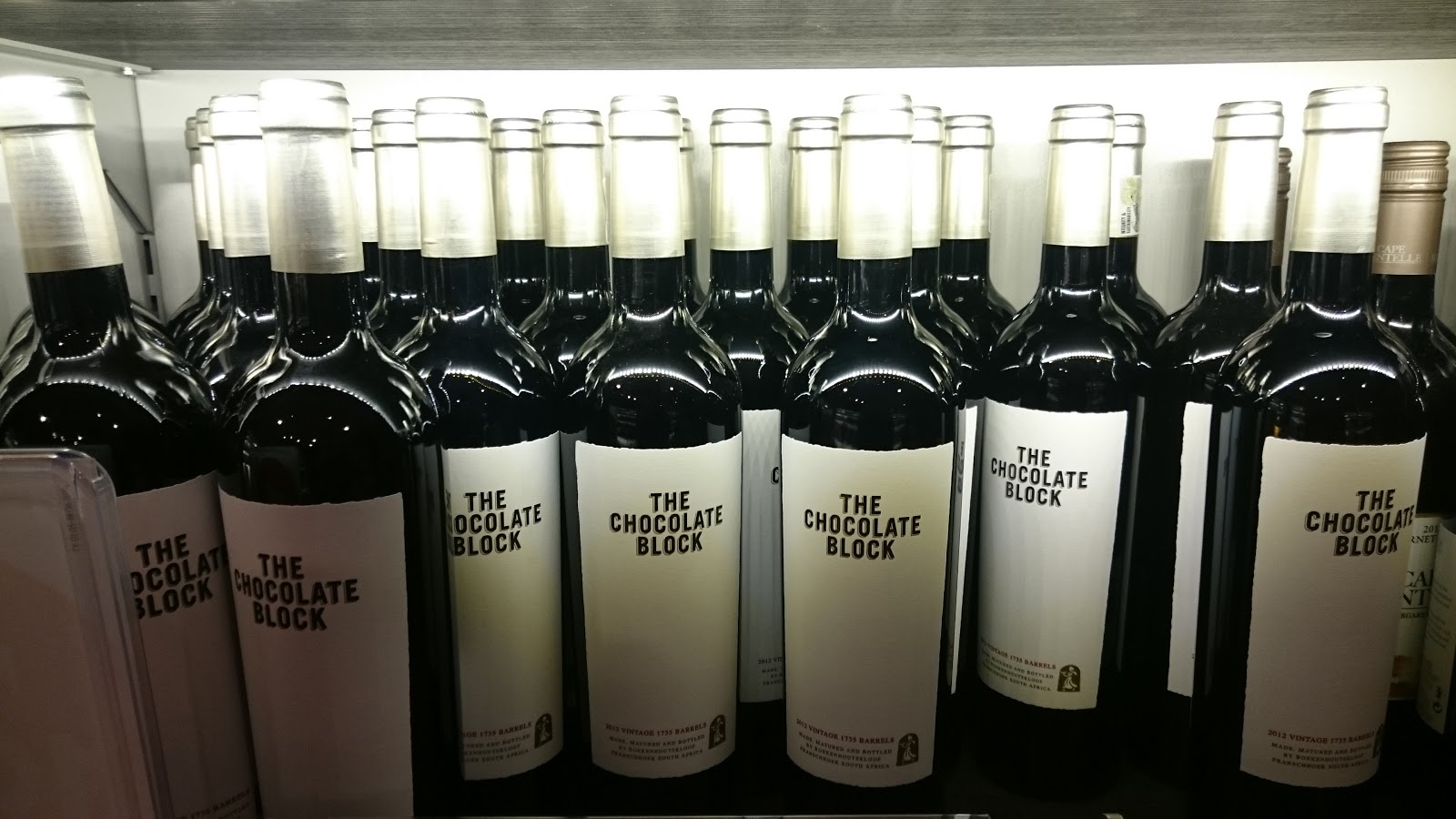
Oh, one bonus of the duty free store on the ship: they had The Chocolate Block wine, one of my favourites. But it cost R300, so I thought: "Rather not". 

Stormy Waters

So.
Last week I went on a cruise from Kiel to Oslo. And forgot my diary in the cabin.
Those pages are a written testament from the moment I left SA, with all the trips, concerts, emotions and thoughts in between recorded in it. I realise full and well it is just paper, it is not the thing of most monetary worth that I could have lost. Yet it matters, because it cannot be replaced. I try to remember what I wrote down. The drawings I did of the covered Muslim ladies at Doha airport with their very fancy footwork. The questioning of whether the winter depression will ever end, whether depression can truly be linked to the darkness outside and is not simply a consequence of not being able to see the wood for the trees. Late night notes on a full moon admired from my bedroom window. Little trips to Copenhagen, Hamburg, Amsterdam. Drawn maps of places where I didn't have internet. Daily anecdotes on the long vacation back home. All these words, lost.

I've had diaries since childhood. In a box at my mother's house a dozen or more are gathering dust. Perhaps each of us has something that saves us, something that makes sense when everything else does not. For the one it may be a form of exercise, for another it may be escaping into WoW or League of Legends or some other alliterated game. It may be a person or a pet or dancing to 'Lotus Flower' when you are alone. Yet (I assume) we all need to flee our minds and our environments at times. And that is what these diaries have provided: a safe space to make sense of things. Not even to make sense so much, rather to release the jumbled mess in my brain onto the neat lines of a page. The written word, the word written in my handwriting, makes the bad and the good better.

My aunt asked me last year why I write. What is the reason to sit down, whether it be in front of a computer or a blank page or a diary or a typewriter or whichever other device you may choose, and to start pouring the words onto paper?

The answer is simple: there is nothing else. It is not about being read by others (although naturally one also wants to be read) or about creating the next great novel or changing the world. This writing is a chance to be selfish, to give all of myself to myself. It is a chance to see how I have changed over the years, how what seemed like mountains at the time could be conquered. It is a testament to the past, stemming from the fear that something might be forgotten. It is writing with my fountain pen when most things are typed these days. It is collecting tiny snippets of concert tickets and everyday conversations. It is knowing that words matter.


Quite fitting: this Scrabble ad. "There's magic in words". Indeed.


Tuesday, 2 June 2015

I feel like I'm just treading water


Not Waving but Drowning

BY STEVIE SMITH 1902–1971

Nobody heard him, the dead man,
But still he lay moaning:
I was much further out than you thought
And not waving but drowning.

Poor chap, he always loved larking
And now he’s dead
It must have been too cold for him his heart gave way,
They said.

Oh, no no no, it was too cold always
(Still the dead one lay moaning)
I was much too far out all my life
And not waving but drowning.


Do the hard times come to a screeching halt at some point? Do things start making sense and all of a sudden you know, you just know, what it is you are doing?

These are restless nights, man. And not just for me. I am not restless in isolation. All around me there is fear mongering towards a generation so unsure of ourselves that we are deer in the headlights, unable to move in any direction even when we know the fucking 18-wheeler is barreling down the highway at top speed and won't stop to spare us. From all sides come the nagging questions about what our plans are, what we intend on doing with our lives, whilst at the same time being told that there are no jobs, that by the time we retire the retirement fund will be empty, global warming will have killed off all the polar bears, China will take over and disasters upon disasters upon disasters will happen. And this is not even considering the small catastrophes that happen at 4 PM on an ordinary Wednesday, the ones where the unthinkable occurs to the ones we love. 

So I am in a constant state of panic about not being able to manage it all, about unsuccessfully multitasking, about where to come 2016. For now there is a plan, for the next 6 months there are barely hours left to breathe. But come 2016, the Fates are reinventing my wheel for what feels like the umpteenth time. 

Logic and experience tell me it will be ok. Everything will be ok. You can't plan this, you have to leave some things in the hands of whatever comes next. Logic and experience tell me I can handle all of it. But still. At times I wish I was made of lesser stuff, that I needed someone besides myself to tell me it will all be ok, that I could remain in one place for the sake of one person, that life within boundaries would be my choice. Instead, an anxiety about wanting more than walls and 9-to-5s and a daily dullness challenges the fear I have of being much too far out all my life and not waving but drowning.